How Many Lumens Does a 2 Car Garage Need?
A 2 car garage usually needs about 8,000 to 20,000 lumens of total light for general use, with more useful light aimed at work areas if you do repairs or detailed projects. Room size, ceiling height, fixture placement, and the light's spread all affect the result.
On this page (7 sections)
- How many lumens for a 2 car garage should you plan?
- What changes the lumen target?
- Should you use one bright fixture or several lights?
- Which lights fit different two-car garage plans?
- How can you tell if the garage is bright enough?
- What color temperature works for a garage?
- How many lumens for a 2 car garage should you choose?
A 2 car garage usually needs about 8,000 to 20,000 lumens of total light for general use, with extra light over work areas for repairs and detailed projects. The right amount depends on room size, ceiling height, fixture placement, and how evenly light reaches the floor and walls.
Lumens measure the light a source gives off. They don't tell you how bright every spot in the garage will feel, because spacing, beam spread, shadows, and surface color matter too.
How many lumens for a 2 car garage should you plan?
For basic parking and storage, start near 8,000 to 10,000 total lumens. For a garage used as a workshop, aim closer to 15,000 to 20,000 lumens, then add task lighting where you need to see details.
These are planning ranges, not a guarantee of even coverage. A low ceiling with several well-spaced fixtures can feel brighter than a high ceiling with the same total output in one fixture.
Before buying lights, measure the garage and note where you park, store items, and work. Our guide to how to light a garage explains how to plan fixture positions around those uses.
What changes the lumen target?
The target changes with room size, ceiling height, surface color, and the work you do. A larger or taller garage needs more light to cover the same floor area.
Dark walls and ceilings absorb more light than pale ones. Shelves, vehicles, and stored items also block light, so a layout that looks sufficient on paper can leave dim corners.
Detailed work calls for more light where the task happens, not necessarily a brighter room everywhere. You may need a focused fixture over a bench or a portable light for work under a vehicle.
How does ceiling height affect garage lighting?
Higher ceilings make it harder to get useful light down to the floor and work surfaces. A fixture with high output can still leave areas dim if it is poorly placed or its beam doesn't spread across the space.
For tall garages, compare fixture options in our guide to high bay shop lights. Match the light's installation requirements and coverage to your ceiling before choosing by lumen number alone.
Should you use one bright fixture or several lights?
Several fixtures usually make it easier to spread light across the garage and reduce dark gaps. One high-output light can leave corners, work areas, or the space between parked vehicles in shadow.
Think in zones: parking, storage, and workbench. Place lights so each zone receives useful light, and avoid positioning fixtures where a car roof or open door blocks it.
A product's lumen figure describes its output, not how well it covers your exact room. For more layout ideas, see garage ceiling light options for even coverage.
Which lights fit different two-car garage plans?
Choose lights based on the area they need to cover and how you use the garage. The following options cover a long fixture, a set of four-foot lights, and a high-output hex layout.
Are long shop lights a good fit?
Long fixtures can suit garages where you want light distributed along the ceiling. The ELEKICO set has 8-foot linkable lights, with a stated 19,500 lumens per light and 5,000K color.
Plan fixture locations before installing them, and check that the total output and coverage suit your space. Linkable lights can be a fit for a larger area, but output alone doesn't show whether the corners or bench will be well lit.
Would several four-foot lights work better?
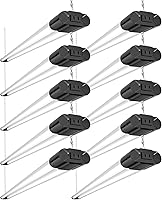
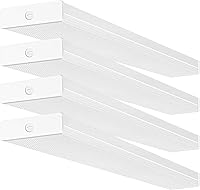
Four-foot fixtures can give you more placement options across the ceiling. Barrina's 10-pack has lights rated at 5,500 lumens each, with a 270-degree beam angle and connections for linking up to 6 in a series.
The set supports hardwiring or use with power cords and switches. Check the installation method, wiring, and fixture spacing against your garage before planning the layout.
When does a hexagon layout make sense?
A hexagon layout may suit a garage where you want a bright ceiling feature for detailing or close visual work. LZHOME gives this 8-hex system a stated total output of 40,000 lumens at 5,000K.
That amount may be more than needed for simple parking, and the layout should fit the room without creating uncomfortable glare. Consider how the pattern will sit above vehicles and work areas before choosing it.
How can you tell if the garage is bright enough?
The garage is bright enough when you can see the floor, stored items, and task surfaces without persistent dark patches or glare. Check the space at night with the doors closed, since daylight can hide weak spots.
Stand where you park, work, and move between zones. Look for shadows cast by cabinets, vehicles, and open doors, then shift or add fixtures to address those areas.
Don't judge by the total lumens printed on a package alone. Two layouts with similar output can feel different because of beam spread and spacing.
What color temperature works for a garage?
Many garage lights use daylight-white color around 5,000K, which can make tools and surfaces easier to distinguish. The right choice is also a matter of preference, especially if the garage connects to living space.
The three product options above are specified at 5,000K. Compare light color choices in our guide to 4000K vs 5000K for a garage.
How many lumens for a 2 car garage should you choose?
For basic parking and storage, begin around 8,000 to 10,000 total lumens and check coverage across the room. For regular projects or a workshop setup, plan closer to 15,000 to 20,000 lumens, with extra task light at the bench or repair area.
Choose several well-spaced fixtures when coverage matters across the whole ceiling. Consider a long linkable set for a long layout, four-foot lights when flexible spacing helps, or a hex system for a bright ceiling pattern.
Use the garage lighting planning guide to compare layouts and safety points before installation. If most of your time is spent working at a bench, our guide to shop lights for a garage can help narrow the fixture style.
Frequently asked questions
How many lumens do I need for a 2 car garage?
Plan for roughly 8,000 to 20,000 lumens of total light for general use in a typical two-car garage. Choose the lower part of that range for basic parking and storage, and add light over a workbench or project area when you need to see details.
Room dimensions and fixture placement change the result.
Is 10,000 lumens enough for a 2 car garage?
It can be enough for parking, storage, and basic tasks in a modest two-car garage if the fixtures spread light evenly. It may feel dim over a workbench or at the edges, especially with a high ceiling or dark finishes.
Check coverage and add focused task lighting where you work.
How many lumens do I need for a garage workbench?
A workbench often needs more concentrated light than the surrounding garage. Start with a bright fixture positioned to reduce shadows, then check whether the bench surface and tools are easy to see during the tasks you do.
A portable work light can help with close-up jobs without raising the whole room's brightness.
Is 40,000 lumens too bright for a 2 car garage?
It may be more light than you want for ordinary parking and storage, particularly if it comes from one concentrated fixture or shines into your eyes. For detailing or other close visual work, high output can be useful when spread across the ceiling.
Use placement and separate task lighting to control glare.