9 Best LED Screw-In Garage Ceiling Lights (November 2026)
The best LED screw-in garage ceiling lights include the POLARPRA LED Garage Light for most garages, the CHENGCHILIT LED Garage Light for maximum brightness, and the LAMLAMCK Garage Light for large shops and barns.
On this page (5 sections)
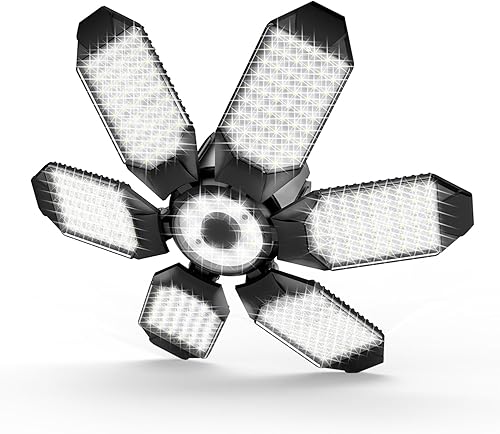
The best LED screw-in garage light for most garages is the POLARPRA 160W, because its six folding panels turn one ordinary socket into 16,000 lumens of aimable daylight. Go brighter with the LAMLAMCK 240W, or softer with the SANSI 3-Panel at 5000K.
A screw-in light is the easiest garage lighting upgrade you can make. You keep the socket you already have and skip the wiring, the electrician and the ladder work beyond a single twist.
That matters in a garage, where the ceiling is often bare bulb sockets and running new cable means moving stored gear out of the way first.
The trick is picking the right one for your bay size, ceiling height and the work you do under it. Panel count, lumen output, color temperature and the size of the folded light all change how the room feels once it is up.
That is what this guide sorts out, so you can stop squinting at the floor lines and get on with the job.
Our picks at a glance
-
1
-
2
-
3

- 4
 Check it
SANSI 3-Panel Deformable LED Garage Light
Best for softer daylight - 5
 Check it
TOPAUBUB Garage Lights 2 Pack 120W
Best for two-socket garages - 6
 Check it
AUDLES 2 Pack LED Garage Light
Best for quick DIY swaps - 7
 Check it
PINSAI 2 Packs LED Garage Light
Best for shadow-free work areas - 8
 Check it
Maliralt LED Garage Lights Bulb 6 Pack
Best for whole-property lighting - 9
 Check it
Bell+Howell TRIBURST 3 Panel Screw in LED
Best for warmer light
Which LED screw-in garage ceiling lights fit each job
The POLARPRA earns the top spot for most people, while the other picks are the best choice for a named need, from huge shops to warmer light. Match the light to the room before you compare panel counts.
A light that is too bright for a small bay glares and washes out detail, and a light that is too dim for a tall shop leaves the floor in shadow.
POLARPRA LED Garage Light: Best for most garages
- 16,000 lumens
- 6 deformable panels
- 6500K daylight
- E26/E27 screw base
Six folding panels and 16,000 lumens turn one ordinary socket into broad, aimable garage light. The aluminum heatsink helps it run cool.
Pros
- Six aimable panels
- Aluminum heatsink
- Screws into any E26/E27 base
Cons
- Not dimmable
- No motion sensor
POLARPRA is the light to buy if you want one fixture to handle a typical one or two-car garage. Its six deformable panels fold out and aim independently, so you can push light onto the workbench and the far wall instead of blasting one bright spot.
That flexibility matters when the socket sits off-center and the room has corners the bulb alone would miss.
At 16,000 lumens and 6500K it reads as daylight, and the 120-degree beam spreads across the bay. The hollowed ABS body with an aluminum heatsink is built to shed heat, and POLARPRA rates the light at 50,000 hours.
The E26 base and BR30 shape mean it drops into a socket built for an ordinary bulb.
It screws into any E26 or E27 base with no tools. The trade-off is that it is not dimmable and there is no motion sensor, so it stays on at full output until you flip the switch.
For hands-free control, see our picks for LED garage lights with motion sensor.
CHENGCHILIT LED Garage Light: Best for maximum brightness
- 20,000 lumens
- 7+1 deformable panels
- 6500K daylight
- CRI above 80
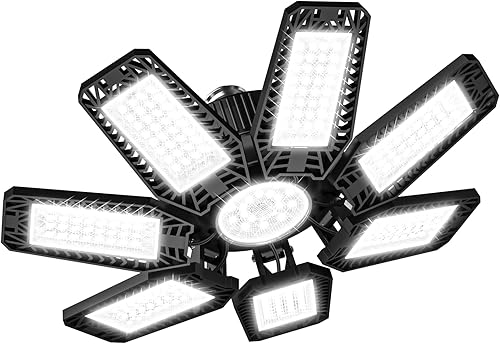
248 LED beads across seven folding panels deliver the brightest light here. The central panel fills the middle while the wings reach the corners.
Pros
- Brightest 7-panel single
- Seven folding panels plus center light
- Hollowed aluminum heatsink
Cons
- Daylight color only
- Needs a socket rated for the load
CHENGCHILIT is the pick when brightness is the whole point. Its 7+1 panel layout and 20,000 lumens make it the brightest 7-panel single in this roundup, which suits a big open garage or a shop where you need to see fine detail.
The 248 LED beads sit across the seven wings and the center panel.
The seven folding panels plus a central light cover a wider area than five or six-leaf designs, and the CRI above 80 keeps colors truer under the light. A hollowed aluminum heatsink and an upgraded driver handle the heat and keep output steady.
At 5.46 inches across and 4.2 inches tall when folded, it stays compact for its output.
It uses the same E26/E27 screw base, so installation is a bulb swap. Choose it over the POLARPRA when raw light matters more than a slightly smaller footprint.
If you plan a larger layout, our guide to how to install hexagon garage lights walks through panel placement.
LAMLAMCK Garage Light: Best for large shops and barns
- 24,000 lumens
- 8+1 panels
- 6500K daylight
- Wide 85 to 265 volt input
Nine total panels and 24,000 lumens cover a big open bay. The wide voltage input and constant-current driver keep output steady.
Pros
- Highest lumen count here
- Nine panels for 360-degree coverage
- Wide voltage range
Cons
- Large folded footprint
- Cool white light only
LAMLAMCK is built for large spaces. Its 8+1 panels and 24,000 lumens top the lumen count here, so a barn, workshop or deep garage gets full coverage from a single fixture.
The 264 lamp beads and 240W draw put it in a class of its own for raw reach.
Each panel folds from 0 to 90 degrees, and LAMLAMCK says the design gives 360-degree lighting to solve the uneven spread of simpler 3 to 6-blade lights. A constant-current driver and wide 85 to 265 volt input keep it stable, which helps in older buildings where voltage sags when a compressor kicks on.
The folded shape is big, so measure clearance to the door track and any shelves before you commit. It suits a room where the ceiling is open and you want maximum light.
For a room with standard ceiling boxes, compare the garage ceiling lights that mount flush instead.
SANSI 3-Panel Deformable LED Garage Light: Best for softer daylight
- 3,300 lumens
- 5000K daylight
- 3 folding panels
- ETL certified
A 30W bulb that replaces a 300W incandescent and gives softer 5000K light. The ceramic cooling design suits smaller garages and utility rooms.
Pros
- Soft 5000K daylight
- Uses only 30W
- Ceramic heat dissipation
Cons
- Lower output than the big panels
- Fewer panels to aim
SANSI is the softer choice. Its 5000K daylight and 3,300 lumens give a warmer feel than the 6500K picks, and the 30W draw replaces a 300W incandescent without the heat or the bill.
The ETL listing adds a safety check that some cheaper panels skip.
Three panels adjust from 0 to 90 degrees for wide-angle light. SANSI uses a patented ceramic cooling design in place of the usual aluminum board, and rates the light at up to 22.5 years of use.
The body is built with V-0 flame retardant material. At 7.84 ounces it is light enough for a flimsy fixture.
The lower output means it suits a smaller garage, a utility room or a basement rather than a deep two-bay shop. If you want a warm, energy-light light for a room you use at night, this is the one to pick.
For a full-size bay, the brighter panels above do more.
TOPAUBUB Garage Lights 2 Pack 120W: Best for two-socket garages
- 2-pack
- 12,000 lumens each
- 4+1 panels
- 6500K daylight
Two 120W lights cover a two-bay garage without buying singles. Each has four folding panels plus a round center panel.
Pros
- Two lights in one box
- Four folding panels each
- Flicker-free driver
Cons
- Each light is less bright than the top picks
- Bulkier pair to store
TOPAUBUB is the practical pick for a two-socket garage. The 2-pack gives you two 120W lights, each with four folding panels and a round center panel, so both bays get even light without buying singles.
Spreading two lights beats one in a wide room.
Each light puts out 12,000 lumens at 6500K with a CRI above 80. The driver is built to be flicker-free and glare-free, and the hollowed body speeds heat loss.
SMD2835 chips keep the output steady across the panels, and each unit measures 9.76 inches across and 4.09 inches tall when open.
The trade-off is that each light is dimmer than the single top picks, so a very large bay may want the brighter panels instead. For a standard two-car garage with two existing sockets, the pair is the simplest way to light the whole floor.
Two 12,000-lumen lights usually read brighter across the room than one 16,000-lumen unit hung to one side.
AUDLES 2 Pack LED Garage Light: Best for quick DIY swaps
- 2-pack
- 150W
- 4 deformable panels
- 6500K daylight
A pair of 150W screw-in lights that make a fast, tool-free upgrade. The four panels adjust to throw light into corners.
Pros
- Two lights per pack
- No tools needed
- Adjustable panels
Cons
- Panel count lower than the top picks
- Cool white only
AUDLES is the fast-swap option. You get two 150W lights with four deformable panels each, and each one screws into a normal E26/E27 socket without tools or wiring.
The panels fold to aim light into corners.
At 2,000 lumens per light it sits below the single top picks. The adjustable panels help push light into corners, and the heat-dissipation design is meant to keep the light running long-term.
AUDLES offers a 180-day warranty.
The bulbs are rated for over 50,000 hours of life. Pick this pair when you want a quick, budget-friendly upgrade across two sockets and don't need the brightest single fixture.
It is a solid middle ground between price and output. The four panels mean less aiming control than the six and seven-panel picks, so it suits open floors more than tight work areas.
PINSAI 2 Packs LED Garage Light: Best for shadow-free work areas
- 2-pack
- 30,000 lumens total
- 12+1 panels
- Panels fold twice
Thirteen panels per light fold twice for spider-like aiming. This pair is built to flood a workbench or maintenance bay without shadows.
Pros
- Thirteen panels per light
- Panels stretch and fold twice
- High total output
Cons
- Large folded shape needs clearance
- Cool white only
PINSAI is for work areas where shadows get in the way. Each light has 12+1 panels that fold twice, letting you aim light like a spider from 120 to 240 degrees to kill shadows over a bench or engine bay.
The second fold gives angles a single-hinge panel cannot reach.
The pair totals 30,000 lumens across two lights, and the polycarbonate housing is rated for temperatures from 20 below zero to 70 above. The hollowed body speeds cooling and the screw base keeps install simple.
At 1.2 pounds per light it hangs easily.
The catch is size: 13 panels make a wide folded shape, so check clearance around the socket. It suits a dedicated maintenance bay or a garage where you do detailed work, not a tight parking-only space.
If your socket sits close to the door track, measure before you buy.
Maliralt LED Garage Lights Bulb 6 Pack: Best for whole-property lighting
- 6-pack
- 18,000 lumens
- 6 deformable panels
- 80,000-hour rated life
Six screw-in lights cover a garage plus a shed, attic or carport. Each one has six folding panels and a hollowed body for cooling.
Pros
- Six lights in one box
- Six folding panels each
- Suits several rooms
Cons
- Large order for a single garage
- Daylight color only
Maliralt covers more than one room. The 6-pack gives you six lights, enough for a garage plus a shed, attic or carport without buying separately.
The bulbs suit a landlord or anyone lighting several spaces at once.
Each light has six folding panels that adjust from 0 to 90 degrees for 360-degree coverage. The hollowed design is rated to 80,000 hours, and the E26/E27 base makes each one a bulb swap.
It works in cold weather too, so a carport or unheated workshop is fair game.
Buying six at once is more than a single garage needs, so this set suits a landlord, a workshop with several rooms or a homeowner lighting a whole property. For one bay, a single brighter pick is the better spend.
Bell+Howell TRIBURST 3 Panel Screw in LED: Best for warmer light
- 4,000 lumens
- 3 panels
- 3500K warm white
- Socket extender included
A warmer 3500K light for garages used as workshops or hangout space. Three panels fold flat and an extender fits deeper fixtures.
Pros
- Warmer 3500K light
- Includes a socket extender
- Panels fold flat
Cons
- Lowest output in this roundup
- Fewer panels than the big picks
Bell+Howell TRIBURST is the warm-light option. Its 3500K color and 4,000 lumens give a softer glow than the daylight picks, which suits a garage used as a hangout, a workshop or a laundry corner.
It reads more like a living-room lamp than a work light.
Three panels fold flat for a low profile, and the kit includes an extender for deeper fixtures. It screws into any E26/E27 socket and Bell+Howell rates it at up to 30,000 hours with rust-resistant hinges.
The extender helps when the socket sits recessed in a deep fixture or a can light.
The lowest output in this roundup is the SANSI at 3,300 lumens, so the TRIBURST sits among the lowest here and is best for small rooms or accent light rather than a big bay. If you want a warm light over a workbench without glare, this is the pick.
For a brighter room, the garage ceiling lights guide covers flush-mount options. In a two-car bay, plan on two or more of these.
How these LED screw-in garage lights compare
The comparison table puts the key facts side by side: lumen output, wattage, color temperature and base type. Use it to shortlist by brightness first, then by color and fit.
Brightness is the hardest spec to judge from a product page, so read it next to the room size you are lighting.
Our score weighs specs, features and buyer feedback against what you're shopping for. The POLARPRA leads on the balance of aimable panels, output and heat design for a typical garage.
The brighter singles score close behind, and the 2-packs trade raw output per light for covering more sockets in one order.
| Product | Best for | Light output | Wattage | Color temperature | Our score |
|---|---|---|---|---|---|
| POLARPRA LED Garage Light | most garages | 16,000 lumens | 160W | 6500 Kelvin | 9.7 |
| CHENGCHILIT LED Garage Light | maximum brightness | 20,000 lumens | 200W | 6500 Kelvin | 9.6 |
| LAMLAMCK Garage Light | large shops and barns | 24,000 lumens | 240W | 6500 Kelvin | 9.2 |
| SANSI 3-Panel Deformable LED Garage Light | softer daylight | 3,300 lumens | 30W | 5000 Kelvin | 9.1 |
| TOPAUBUB Garage Lights 2 Pack 120W | two-socket garages | 12,000 lumens each | 120W each | 6500 Kelvin | 8.6 |
| AUDLES 2 Pack LED Garage Light | quick DIY swaps | 2,000 lumens | 150W | 6500 Kelvin | 8.4 |
| PINSAI 2 Packs LED Garage Light | shadow-free work areas | 30,000 lumens | 280W | 6500 Kelvin | 8.2 |
| Maliralt LED Garage Lights Bulb 6 Pack | whole-property lighting | 12,000 lumens | 120W | 6500 Kelvin | 8.1 |
| Bell+Howell TRIBURST 3 Panel Screw in LED | warmer light | 4,000 lumens | 30W | 3500 Kelvin | 8.0 |
How we compared these screw-in garage lights
We compared the listed specs for output, color temperature, panel count and base type, then matched each light to the room it suits best. Lights with more panels and higher lumens scored higher for big open bays.
A 24,000-lumen light earns its score by reaching a barn floor, while a 4,000-lumen light earns its place in a small room by being warm and low profile.
We also weighed the build details the makers list, like aluminum heatsinks, ceramic cooling and wide voltage input. A light with a defined warranty or safety listing got credit for that.
Heat design matters in a garage, because a panel light left on for hours runs warm, and a hollowed body or a metal sink sheds that heat faster than a sealed plastic shell.
We did not test these lights in a garage. The scores reflect how well each light's stated specs fit a typical buyer's needs, from a one-car bay to a barn.
What should you check before buying a screw-in garage light?
Check three things first: the socket type, the wattage your fixture can handle, and the color temperature you want. A bright light on the wrong socket or in the wrong color wastes money.
Folded size matters too, because a wide panel set can foul a door track or a shelf.
Socket type. Every pick here uses an E26 or E27 base.
E26 is the standard US size and E27 is the European size.
Look at the socket in your ceiling before you buy, and make sure the folded panels clear shelves, the door track and any overhead storage. A socket in a recessed can may need an extender, like the one Bell+Howell includes.
Wattage and circuit load. These lights draw between 30W and 240W.
A 240W light pulls a lot from one socket, so check the fixture's rating and how many lights share the circuit.
If your breaker trips, split the load across sockets. The LAMLAMCK and PINSAI are the heaviest draws here.
Color temperature. 6500K reads as bright daylight and suits parking and detail work.
5000K is a touch softer and 3500K feels warm.
Pick warm light for a garage you sit in and daylight for one you work in. The CRI figure matters too: above 80 keeps paint, wires and tools closer to their real colors.
Should you choose a 2-pack or a single light?
Choose a 2-pack when your garage already has two sockets and you want even light across both bays. A pair like the TOPAUBUB or AUDLES covers a two-car garage without a second order.
Two lights spread across a wide room also cut shadows that one central light leaves at the edges.
Choose a single light when you have one socket or want maximum output from one spot. The POLARPRA and CHENGCHILIT are the brighter singles here.
A pair of dimmer lights can still beat one bright light in a wide room if the sockets are spread apart. Measure the distance between sockets before you decide, since two lights close together act like one.
How much light does your garage actually need?
Aim for at least 8,000 to 10,000 lumens for a one-car garage used for projects. A two-bay garage benefits from two lights or a single 20,000-lumen unit.
Deep bays and high ceilings need more light to reach the floor. Light falls off with distance, so a 16-foot ceiling eats far more output than an 8-foot one.
A screw-in light spreads its output across a wide beam, so the room size and ceiling height matter as much as the lumen count. For a room with a standard 8 to 9 ft ceiling, a 12,000 to 16,000-lumen light is plenty.
Go up to 20,000 to 24,000 lumens for a taller shop or barn. A 3,300 to 4,000-lumen light suits a small utility room, not a double bay.
Do these lights need special wiring?
No. Every light here screws into a standard E26 or E27 socket and needs no wiring or electrician.
Switch off the breaker, screw the light in like a bulb, and turn the power back on. A step stool is usually the only tool you need.
That makes them a good fit for renters and anyone who wants a fast upgrade. If your socket is on a dimmer, check that the light supports dimming.
Most panel lights here do not, so a buzzing or flicker problem is more likely on a dimmer circuit. If yours hums, read why LED lights buzz before you return it.
A plain on-off switch avoids the problem entirely.
Which light is best for a tall ceiling?
For a tall ceiling, pick the brightest light you can fit and aim the panels downward. The LAMLAMCK at 24,000 lumens and the CHENGCHILIT at 20,000 lumens reach a high floor better than the 4,000 to 12,000-lumen picks.
Aim the wings down and out rather than flat, so the beam lands on the floor instead of the walls.
Panel count helps here too. More panels mean more directions to aim light down and across a tall bay.
The PINSAI pair also reaches far with its double-fold panels. If the ceiling is very high and the socket is hard to reach, a flush-mount fixture may suit you better than a screw-in light.
Our guide to garage ceiling lights covers those.
Is a warm-white or daylight screw-in light better in a garage?
Daylight 6500K is the better choice for most garages, because it shows detail and floor lines clearly for parking and work. Warm 3500K suits a garage you use as a room, like a workshop or a hangout corner.
The warm light is easier on the eyes late at night.
The middle option, 5000K, gives a softer daylight that some people prefer at night. Color is personal, so pick the light that matches how you use the room.
If you work on cars or do fine repairs, daylight wins. If you park, store and sometimes sit out there, warm or 5000K feels less clinical.
Verdict: which LED screw-in garage light should you buy?
Buy the POLARPRA 160W for most garages. Its six aimable panels, 16,000 lumens and aluminum heatsink make it the best all-round LED screw-in garage ceiling light here for a typical bay.
It covers a one or two-car garage without the size or the draw of the big panels.
Choose the LAMLAMCK 240W for the most raw output, the CHENGCHILIT 200W for balanced brightness from a multi-panel single, or the SANSI 3-Panel for softer 5000K light. Pick the TOPAUBUB or AUDLES 2-pack when your garage has two sockets to fill.
The PINSAI pair is the pick when shadow-free detail work matters most.
For warmer light in a garage you sit in, the Bell+Howell TRIBURST is the pick. The Maliralt 6-pack makes sense when you are lighting more than one room.
Whatever you choose, confirm the socket type, the folded size and the color temperature first, and the install will take seconds. If you are mapping out a bigger lighting plan, start with the garage ceiling lights guide.
Our top 3 picks at a glance
-
1
-
2
-
3
Frequently asked questions
What does screw-in mean for a garage light?
It means the light fits a standard E26 or E27 bulb socket and installs like a bulb. No wiring or electrician is needed.
You switch off the breaker, screw the light in and turn the power back on.
How bright should a screw-in garage light be?
For a one-car garage used for parking and projects, aim for at least 8,000 to 10,000 lumens. A two-bay garage benefits from two lights or a single 20,000-lumen unit.
Brightness needs rise with ceiling height.
Are LED screw-in garage lights dimmable?
Most deformable panel lights like these are not dimmable. POLARPRA lists its model as not dimmable in its features.
If you need dimming, check the label before buying or use a separate smart bulb.
Will a bright screw-in garage light fit my existing socket?
The top picks here use E26 or E27 bases, which match standard US and European bulb sockets. Check that your fixture's socket is rated for the wattage and that the folded panels clear nearby shelves or the door track.
Can a screw-in garage light go in a covered porch or shed?
These lights are listed for indoor use. A covered porch or shed that stays dry is a reasonable spot, but an open or wet area is not.
Keep the light out of direct rain and splashes.
Why does my new LED garage light buzz?
Buzzing often comes from a dimmer, an older fixture or a loose connection. If yours hums after install, read why LED lights buzz and check the socket and switch before returning the light.